Why Oklahoma Dispensaries Need a POS Built Specifically for OMMA
Most cannabis POS systems are built to serve multiple states. That sounds efficient on a vendor slide. For Oklahoma dispensary operators, it often means local compliance is a configuration layer — not the foundation.
Oklahoma is not a minor variation of another market. OMMA rules, METRC package tracking, patient purchase limits, and inspection culture form a specific operating environment. Software built "for everywhere" usually handles Oklahoma adequately on demo day and painfully on audit day.
This post explains why Oklahoma dispensaries need a POS built specifically for OMMA — and what changes when compliance is native instead of bolted on.
Oklahoma compliance is not a settings panel
Multi-state vendors ship a core product, then enable state modules. Oklahoma gets the same checkout shell as other markets with METRC toggles and patient fields adjusted to local rules.
The gap shows up in daily work:
- patient ID validation that is optional or free-text,
- purchase limits calculated outside the cart,
- METRC uploads batched instead of real-time,
- transfer workflows generic enough to miss Oklahoma manifest details,
- reporting exports shaped for accountants in other states.
OMMA-specific software inverts that model. Oklahoma workflows are the default path every customer runs — not a special configuration documented in a PDF appendix.
What OMMA-specific means in practice
METRC is checkout infrastructure
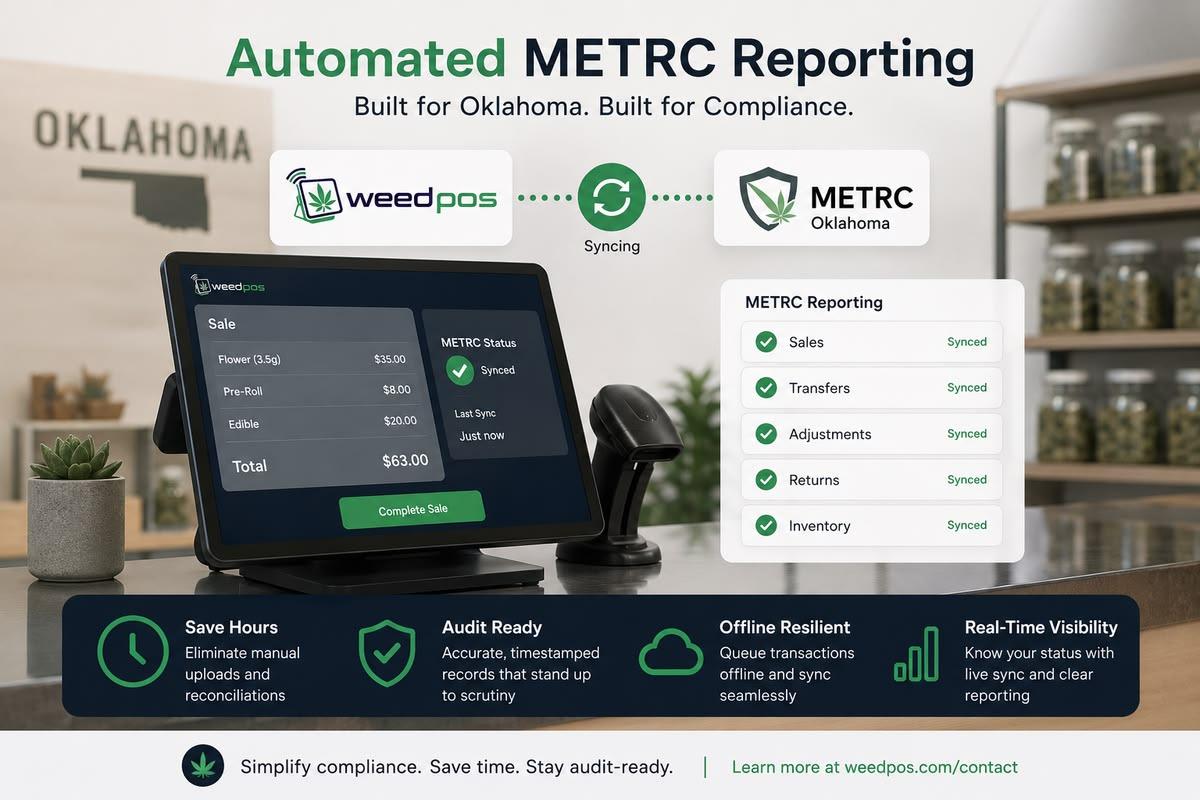
Sales should report to METRC when they ring up. Package inventory should decrement from the correct tag. Adjustments should sync with operator attribution.
METRC compliance is not a back-office module you open after close. It is part of the sale — the same way payment and receipt printing are.
Patient rules live at the register
OMMA patient ID format checks and purchase-limit enforcement belong in the budtender flow. OMMA-specific POS blocks invalid sales before completion instead of trusting busy staff to catch errors.
Our guide on what is OMMA compliance and why your POS matters explains the control-point logic in more detail.
Package inventory matches inspection reality
Inspectors compare shelves to METRC. OMMA-specific retail software tracks packages — not just SKUs — from intake through sale, split, transfer, and adjustment.
Inventory accuracy is a compliance outcome, not only an operations metric.
Documentation fits Oklahoma inspections
License records, lab certificates, and adjustment history should sit beside operational data. OMMA-specific platforms organize compliance documentation the way local inspections expect — not as an afterthought folder.
Multi-state POS vs OMMA-specific POS
| Area | Multi-state POS (configured for OK) | POS built specifically for OMMA |
|---|---|---|
| Engineering priority | Many state modules | Oklahoma retail depth |
| Patient ID | Often free-text or generic | OMMA format validation |
| Purchase limits | Varies by implementation | Native real-time enforcement |
| METRC reporting | Sometimes batched | Designed for per-sale sync |
| Implementation | Config + workarounds | Oklahoma playbook (~2 days) |
| Support context | General cannabis retail | OMMA inspection experience |
| Upgrade risk | OK rules lag behind other states | OK rules ship as core updates |
The right column is what Oklahoma operators mean when they say they want software that "understands this market."
The cost of adapting generic software to OMMA
When software is not OMMA-specific, the dispensary pays in:
- manual METRC reconciliation hours,
- manager overrides for patient limits,
- spreadsheet inventory parallel to the POS,
- training budtenders on compliance workarounds,
- inspection findings that trace back to system gaps.
Those costs rarely appear on a vendor quote. They appear in payroll, risk, and owner time — every week.
Operators switching to OMMA-native platforms often describe the same outcome: the compliance role shrinks because the register finally does what OMMA expects.
Oklahoma market context raises the stakes
Oklahoma remains medical-only with intense competition and a license moratorium through at least 2028. Operators cannot assume recreational growth will forgive sloppy compliance or inefficient operations.
In that environment, OMMA-specific software is a survival tool:
- fewer inspection findings,
- faster checkout in a crowded market,
- cleaner data for margin decisions,
- lower training cost as staff turns over.
Read common challenges facing Oklahoma cannabis retailers for how these pressures show up on the floor.
Weed POS: built for OMMA, not retrofitted for it
Weed POS serves Oklahoma OMMA-licensed dispensaries exclusively. That focus shapes the product:
- automatic METRC reporting at checkout,
- package-level inventory aligned with state records,
- patient ID format checks and purchase-limit enforcement,
- offline mode with queued sync,
- implementation in about two days for typical retail stores.
It is the difference between bending a multi-state platform to Oklahoma and using software where Oklahoma compliance is the product definition.
For a wider view of why operators are migrating off legacy stacks, see why Oklahoma dispensaries are switching to modern cannabis POS.
Evaluating whether your current POS is OMMA-specific
Ask these questions honestly:
- Does every sale report to METRC automatically at checkout?
- Are purchase limits enforced in the cart without manager math?
- Is patient ID validation structural, not optional?
- Can you reconcile packages to METRC inside the POS?
- Did implementation take days — or months of configuration?
- When OMMA rules change, does your vendor ship Oklahoma updates as core?
If you answered no more than twice, you are likely running configured software — not OMMA-specific software.
Conclusion
Oklahoma dispensaries need a POS built specifically for OMMA because compliance here is not a feature toggle. It is the daily operating system of the store.
Multi-state platforms spread attention across markets. OMMA-specific platforms encode Oklahoma inspections, METRC discipline, and patient rules into every sale.
Review pricing, then book a demo to compare your current workflows against an OMMA-native checkout live on your floor.
Frequently asked questions
Why is a multi-state cannabis POS risky for Oklahoma?
Multi-state platforms prioritize breadth over depth. Oklahoma OMMA workflows — patient ID format rules, METRC package tracking, and local inspection patterns — may be supported through configuration rather than native design, leaving gaps that manual work must fill.
What features must an OMMA-specific POS include?
Automatic METRC sales reporting, package-level inventory, patient ID format checks, real-time purchase-limit enforcement, transfer manifest support, offline sync, and audit-ready exports shaped around Oklahoma retail inspections.
Is OMMA-specific the same as METRC integration?
METRC integration is necessary but not sufficient. OMMA-specific software also enforces Oklahoma patient rules, supports local compliance documentation, and reflects how OMMA inspectors evaluate retail operations — not only whether sales uploaded to METRC.
How fast can an Oklahoma dispensary switch to OMMA-specific POS?
Platforms built for Oklahoma typically implement in about two days with package-by-package inventory import, credential setup, and staff training — faster than reconfiguring a multi-state system for local edge cases.
Book a Weed POS Demo
See how Weed POS handles OMMA compliance, inventory, and checkout for Oklahoma dispensaries, all in one operating system.
Related articles

ComplianceJuly 6, 2026
What Is OMMA Compliance and Why Your POS Matters
OMMA compliance is the operating standard for Oklahoma medical dispensaries — and your POS is where package tracking, patient rules, and METRC reporting actually happen.
ComplianceJune 22, 2026
Why Oklahoma Dispensaries Need Automated METRC Reporting
Automated METRC reporting eliminates time taxes and reduces audit risk—here's why Oklahoma stores need it.
ComplianceJune 17, 2026
OMMA Compliance Checklist for 2026
A concise, actionable OMMA compliance checklist for Oklahoma dispensaries in 2026.