What Is OMMA Compliance and Why Your POS Matters

OMMA compliance is the set of rules Oklahoma medical marijuana dispensaries must follow to keep their license and operate legally. It is not a single checklist item or a folder of paperwork. It is how your store handles inventory, patients, sales, transfers, and reporting every day.
For most dispensaries, the POS is where OMMA compliance becomes real. Patient IDs are validated at checkout. Purchase limits are enforced before a sale completes. Packages are deducted from inventory and reported to METRC. When that workflow breaks, compliance becomes a weekend reconciliation project — or an inspection finding.
This post explains what OMMA compliance means in practice, why your POS is the control point, and what Oklahoma operators should expect from cannabis-specific software.
OMMA: the authority behind Oklahoma dispensary rules
The Oklahoma Medical Marijuana Authority (OMMA) licenses and regulates cannabis businesses in the state. Dispensary operators interact with OMMA requirements constantly, even when the work is invisible at the counter.
OMMA oversight includes:
- dispensary licensing and renewal,
- patient and caregiver program rules,
- product testing, labeling, and packaging standards,
- enforcement and inspection procedures,
- coordination with METRC for seed-to-sale tracking.
Compliance is not only about avoiding penalties. In Oklahoma's medical-only, high-competition market, clean operations support patient trust, acquisition interest, and license value during consolidation.
For a full regulatory overview, see our OMMA compliance checklist for 2026.
METRC: how Oklahoma tracks cannabis packages
OMMA relies on METRC as the state's track-and-trace platform. Every package on your shelf should exist in METRC with an accurate quantity. Every sale should report to METRC. Transfers and adjustments should document who changed what and why.
Inspectors routinely compare physical inventory to METRC records. Drift between the two is one of the fastest paths to deeper scrutiny.
METRC compliance belongs inside your POS workflow — not in a separate upload process your team remembers at closing time. When sales report automatically at checkout, METRC stays current and managers stop rebuilding the day from receipts.
Where OMMA compliance happens on a dispensary floor
| Compliance area | Where it must work | POS role |
|---|---|---|
| Patient ID validation | Register | Format checks before sale completes |
| Purchase limits | Register | Real-time calculation during cart build |
| Package sales | Register | Deduct correct METRC tag per line item |
| Sales reporting | Register → METRC | Automatic state sync at transaction time |
| Inventory adjustments | Back office / inventory | Logged with operator and reason code |
| Transfer manifests | Shipping / inventory | Built from live package data |
| Audit documentation | Reporting | Exportable transaction and adjustment history |
If your POS only handles the first row — ringing up a total — everything else becomes manual labor. That is how stores end up with a "compliance person" whose full job is fixing records the register should have kept correctly.
Patient rules: the compliance step budtenders feel most
Oklahoma patient sales require valid credentials and enforced purchase limits. These rules protect patients and licenses alike.
A compliant POS:
- validates OMMA patient ID format at checkout,
- blocks expired or malformed credentials,
- calculates purchase envelopes as products scan,
- stops over-limit sales before they complete,
- records the validation in the audit trail.
Generic retail software cannot do this natively. Teams improvise with notes, calculators, and manager overrides — exactly the pattern inspectors flag.
Our post on patient ID checks and purchase limits walks through the counter-level workflow in detail.
Inventory and package tracking under OMMA
OMMA expects package-level accuracy, not rough category counts. Each product on the shelf should map to a METRC tag with a traceable history.
Dispensary inventory software should support:
- package intake from manifests,
- splits and combines with state sync,
- low-stock and discrepancy alerts,
- cycle counts tied to METRC reconciliation,
- lab certificate attachment on intake.
When inventory lives only in spreadsheets, the POS and METRC diverge. OMMA compliance becomes a hunt for which number is "right" — instead of one system everyone trusts.
Documentation OMMA inspectors expect
Beyond live inventory, operators need organized compliance documentation:
- license records and renewal dates,
- lab test results tied to batches,
- adjustment logs with operator attribution,
- transfer and manifest history,
- sales records that match METRC.
A POS that stores operational and compliance data in one platform produces inspection answers in minutes. A fragmented stack produces weekends of reconstruction.
Use our OMMA compliance checklist for 2026 as a quarterly self-audit alongside daily POS workflows.
Generic POS vs OMMA-ready cannabis POS
| Capability | Generic retail POS | OMMA-ready cannabis POS |
|---|---|---|
| METRC sales reporting | Manual or absent | Automatic at checkout |
| Package inventory | SKU-level only | Tag-level with METRC sync |
| Patient ID checks | Free-text customer field | OMMA format validation |
| Purchase limits | Not supported | Enforced in real time |
| Offline sales | Risk of lost records | Queued sync with timestamps |
| Inspection exports | Rebuilt from multiple tools | Unified reporting |
The right-hand column is not luxury software for large operators. It is the baseline for running an Oklahoma dispensary without carrying hidden compliance labor.
Why POS choice is a compliance decision
Owners sometimes treat POS selection as a checkout decision — speed, price, hardware. In Oklahoma, it is also a compliance architecture decision.
The wrong system externalizes OMMA work to staff: manual METRC uploads, spreadsheet inventory, manager overrides for limits, end-of-day panic when numbers do not match.
The right system internalizes compliance into the sale. Budtenders keep moving. METRC stays current. Managers review exceptions instead of rebuilding every day.
Weed POS was built for Oklahoma OMMA from day one — automatic METRC reporting, package-level inventory, patient ID format checks, and purchase-limit enforcement in the same register flow.
Getting audit-ready without adding headcount
OMMA compliance does not require a larger back office. It requires software that stops errors at the source.
Practical steps:
- Confirm every register reports sales to METRC automatically.
- Reconcile package counts against METRC weekly.
- Test patient ID and limit enforcement with realistic scenarios.
- Centralize license and lab documentation in one system.
- Export reports your accountant and inspectors can use without manual fixes.
If step one fails, the rest is compensating for the register.
Conclusion
OMMA compliance is how your dispensary proves it operates legally in Oklahoma — through accurate METRC records, valid patient sales, and documentation you can produce on demand.
Your POS is where that proof is created. Choose software that makes compliance the default outcome of every transaction, not a separate job after the store closes.
Review pricing, then schedule a demo to see OMMA workflows — patient checks, package sales, and METRC sync — on your floor.
Frequently asked questions
What is OMMA compliance for dispensaries?
OMMA compliance means following Oklahoma Medical Marijuana Authority rules for licensing, inventory tracking, patient sales, product testing, packaging, and record-keeping. Dispensaries must keep accurate METRC records, enforce patient purchase limits, and maintain documentation inspectors can review.
Why does POS software matter for OMMA compliance?
Most OMMA compliance actions happen at the register: patient ID validation, purchase-limit enforcement, package sales, and METRC reporting. A cannabis POS built for Oklahoma automates those steps. A generic register forces manual workarounds that create audit risk.
What is the difference between OMMA compliance and METRC?
OMMA is the state regulatory authority that licenses and inspects cannabis businesses. METRC is Oklahoma's track-and-trace system for package-level inventory and sales. Dispensaries must satisfy OMMA rules using accurate METRC data — usually through integrated POS reporting.
What happens if a dispensary fails an OMMA inspection?
Findings can range from corrective action plans to fines or license jeopardy depending on severity. Inventory mismatches, missing sales records, and patient limit violations are common triggers. Strong POS workflows reduce those findings before inspectors arrive.
Book a Weed POS Demo
See how Weed POS handles OMMA compliance, inventory, and checkout for Oklahoma dispensaries, all in one operating system.
Related articles
ComplianceJuly 16, 2026
Why Oklahoma Dispensaries Need a POS Built Specifically for OMMA
Multi-state cannabis POS platforms spread compliance thin. Oklahoma dispensaries need software built for OMMA workflows — METRC, patient limits, and package inventory from day one.
ComplianceJune 22, 2026
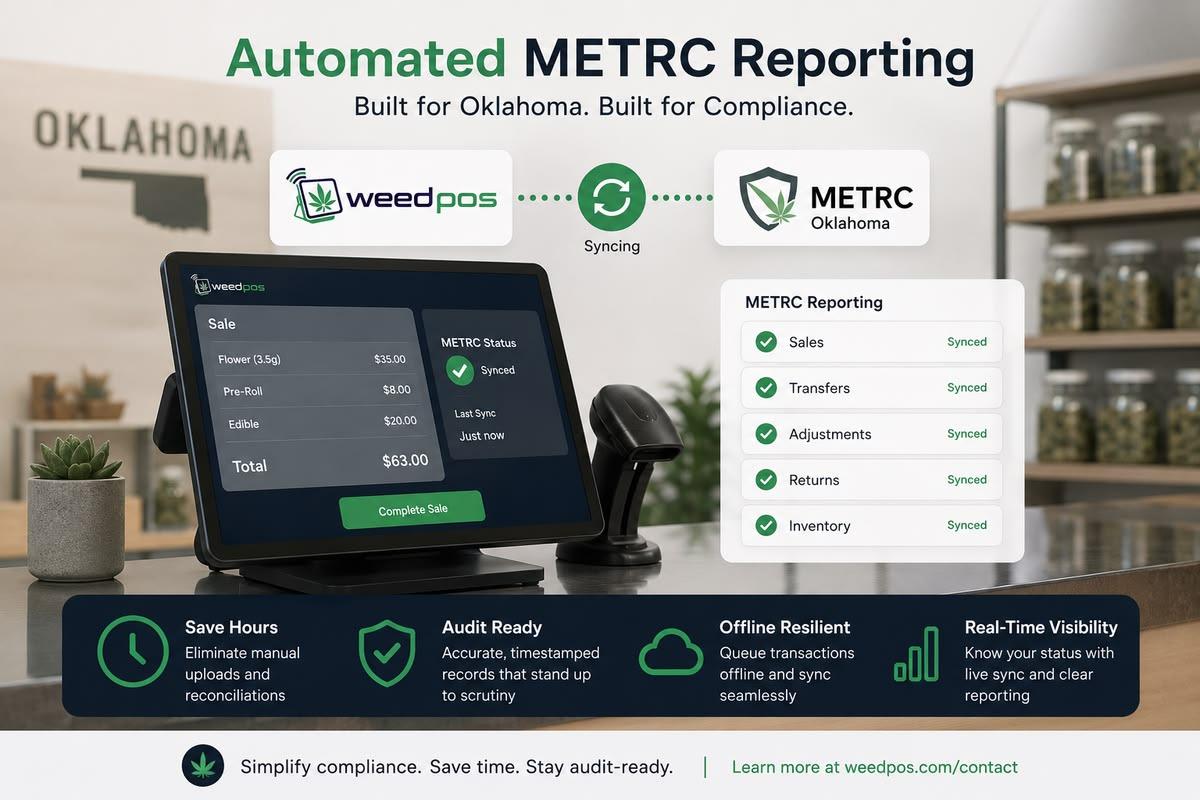
Why Oklahoma Dispensaries Need Automated METRC Reporting
Automated METRC reporting eliminates time taxes and reduces audit risk—here's why Oklahoma stores need it.
ComplianceJune 17, 2026
OMMA Compliance Checklist for 2026
A concise, actionable OMMA compliance checklist for Oklahoma dispensaries in 2026.