Why Oklahoma Dispensaries Are Switching to Modern Cannabis POS Systems in 2026
It is Friday at 6:40 in the evening. The line is twelve patients deep, two budtenders are heads-down at the registers, and the third just walked back from the vault with a fresh box of product. Then the register hangs. The card reader spins. A patient who has been waiting eight minutes shifts their weight and checks their phone. The manager crouches behind the counter, restarts the terminal, and silently prays the day's sales did not just disappear into a generic retail system that was never built for this. The short answer to why operators are switching: generic registers turn OMMA compliance into hours of weekly manual work that a cannabis-native POS simply handles on its own.
Every Oklahoma dispensary operator knows some version of that night. The tooling that got you through your first year — a borrowed retail register, a stack of spreadsheets, a compliance "process" that lives mostly in one person's head — stops scaling somewhere around the point where you are doing real volume. The failures rarely show up as a single catastrophe. They show up as friction: a few extra minutes per transaction, an hour of reconciliation after close, a half-day every month spent stitching together numbers for OMMA and your accountant.
The smart way to count that cost is not in dollars. It is in hours. Hours your manager spends reconciling inventory against the state instead of training staff. Hours your budtenders lose to a slow checkout on a busy night. Hours you personally burn assembling reports that a purpose-built system would have generated while you slept. That is the math driving a wave of Oklahoma dispensaries off legacy tooling and onto modern, OMMA-native point of sale in 2026.
The real cost of running a dispensary on a generic POS
A generic retail POS is genuinely good at one thing: ringing up a sale and taking a payment. The problem is that a cannabis dispensary in Oklahoma is not a generic retailer. You operate inside a seed-to-sale regulatory framework, and a register that does not understand that framework quietly pushes all of the compliance work onto your people.
Start with reporting. METRC is Oklahoma's seed-to-sale tracking system, and every dispensary is responsible for keeping its sales and inventory data matched to the state. A generic POS has no idea METRC exists. So somebody on your team becomes the bridge. They pull the day's transactions, format them, and report them by hand. Done daily, that is a tax on every single shift. Skipped and batched to the end of the week, it becomes a multi-hour reconciliation marathon where small errors compound into the kind of discrepancy that turns an audit into a bad afternoon.
Then there is the spreadsheet layer. When the POS does not track inventory the way the state does, operators build a parallel universe in Google Sheets — one tab for what is on the shelf, another for what the state thinks is on the shelf, and a running list of the differences nobody has had time to resolve. It works until it does not. The first time those two numbers drift far enough apart, you are not reconciling a spreadsheet anymore. You are reconstructing history.
ID handling is the quietest risk of the three, and arguably the most dangerous. A generic register has no concept of a medical patient or a purchase limit. It will happily ring up a sale to an expired card or a malformed ID, because to that system a customer is a customer. Catching those errors becomes a human responsibility at the busiest possible moment — the counter, during a rush — which is exactly when humans make mistakes. Each one is a compliance exposure you will not discover until later, if you discover it at all.
None of this is a knock on your staff. It is a knock on asking good people to manually perform work that software should be doing for them. Every hour spent reconciling, reformatting, and double-checking is an hour not spent selling, training, or going home on time.
What "modern cannabis POS" actually means in 2026
"Modern cannabis POS" gets thrown around loosely, so it is worth defining. The clearest way to see the difference is to look at where the compliance work lives. On a generic system, compliance is something your team does — a checklist run after the fact. On a modern cannabis platform, compliance is something the system is. State reporting is built in, so every transaction is recorded with OMMA at the moment it happens rather than uploaded later. Inventory is tracked at the package level, matched to the state's records, so the numbers on your shelf and the numbers OMMA sees do not drift in the first place. Patient checks live at the register, where the sale actually happens, instead of in a manager's memory.
That shift — from compliance-as-task to compliance-as-property — is the whole category in one sentence. When the platform owns the regulatory plumbing, the failure modes change. You stop asking "did someone report today's sales?" because the question no longer makes sense; the sales reported themselves. You stop maintaining a shadow inventory spreadsheet because the live inventory already agrees with the state. The work does not get faster. It disappears.
A few capabilities define the modern category in 2026. Sales recorded automatically with the state at the point of sale. Package-level inventory that stays matched to state records by design. Patient ID checks and purchase-limit enforcement at the counter. An offline mode so a dropped connection never costs you a sale. And reporting built for the two audiences that actually consume it: the state, and your accountant. Anything missing those is a register, not a cannabis POS.
Compliance: the number one reason operators switch
Ask a room of Oklahoma operators why they finally changed systems, and the answer is almost always compliance. Not because they were out of compliance, but because staying compliant on legacy tooling was eating their week and keeping them up at night.
The fix that built-in METRC compliance provides is structural. Instead of recording sales and then reporting them to the state as a separate step, the recording is the reporting. Every sale is logged with OMMA the moment it rings up — patient sales, returns, and refunds included. There is no end-of-day upload to remember, no batch to reconcile, no window where your register and the state silently disagree.
Audit-readiness is the part operators underrate until they need it. On a generic system, an unannounced inspection means a scramble: pulling records, matching them against the state, explaining gaps. On a platform built for OMMA, the audit trail already exists because the system has been building it transaction by transaction. Inventory adjustments are a good example. When a package is adjusted for spoilage, breakage, or sampling, the system captures the operator's name, the reason code, the timestamp, and the prior value automatically. A year of that history sits on a single screen. When an inspector asks what happened to a package three weeks ago, you do not have to remember. The record already knows.
That is the difference between being audit-ready on audit day and being audit-ready every day. The first is a performance you hope to pull off. The second is just how the system works. For a deeper look at what automated state reporting saves week to week, see our guide to METRC compliance made simple.
Inventory accuracy that matches what OMMA sees
Inventory is where the spreadsheet habit does the most damage, and where a modern platform earns its keep fastest. The promise of solid inventory management is simple to state and hard to fake: your numbers always match what OMMA sees, because the system does the package-level math for you instead of leaving it to a manager and a calculator.
In practice that means handling the operations that actually happen on a dispensary floor without breaking the chain of custody. Packages get split when you break a bulk unit down for the shelf. Packages get combined. Quantities get adjusted. On a generic system, each of those is a manual edit in two places — the register and the shadow spreadsheet — and a chance for the two to diverge. On a package-aware platform, a split or combine is a tracked operation that keeps both your count and the state's count correct at the same time.
The other half is catching drift before it becomes a problem. When something looks off — a count that does not line up, a manifest that has not cleared — the system raises a reconciliation alert that names exactly what changed and when. Most discrepancies are small and boring: a transfer manifest still in transit, an off-by-one adjustment. Caught early, they are a two-minute fix. Left to accumulate in a spreadsheet nobody has time to audit, they are the reason a routine inspection goes sideways. The whole point of package-level tracking is that you resolve the small things while they are still small.
Checkout speed and the patient experience
Compliance and inventory are why owners switch. Checkout speed is why budtenders stop complaining about the switch a week later. The counter is where your patients form their opinion of your store, and a faster, calmer register is a real competitive edge in a market as dense as Oklahoma's.
The first win is at the ID. A modern cannabis POS runs a patient ID format check at the register before a sale rings up, so expired and malformed IDs are caught at the counter rather than surfacing during an audit. That moves a compliance check from a thing a budtender has to remember to a thing the system simply does. It is faster and it is safer, which is a rare combination.
The second win is resilience. Oklahoma has plenty of dispensaries on connections that are not exactly enterprise-grade, and a cloud register that dies the moment the internet hiccups is a liability on a busy night. Offline mode keeps the POS running locally — ringing up patients, taking payment, printing receipts — and queues every transaction with the correct compliance fields. When the connection returns, the queued sales sync to the state automatically, in order, with their original timestamps. A flaky connection becomes a non-event instead of a line out the door.
The third win is onboarding. A checkout flow that a new budtender can learn in a single shift is not a nice-to-have in an industry with the turnover cannabis retail sees. When the register is intuitive, training time drops, your veteran staff stop babysitting new hires through every transaction, and the counter keeps moving even when you are short-handed. Speed at the register compounds: every saved minute is multiplied by every transaction, every shift, every store.
Legacy POS vs modern cannabis POS
The contrast is easiest to see side by side. The rows below are the differences operators actually feel week to week.
| Capability | Legacy / generic POS | Modern cannabis POS |
|---|---|---|
| OMMA reporting | Manual upload after the fact | Recorded with the state automatically at sale time |
| Inventory tracking | Shadow spreadsheet, reconciled by hand | Package-level, matched to state records by design |
| Patient ID format checks | Budtender's responsibility at the counter | Format checked at the register before the sale rings up |
| Offline sales | Register goes down with the internet | Sales queue locally, sync automatically on reconnect |
| Audit prep time | A scramble of pulling and matching records | Audit trail already built, ready on any given day |
| Staff training time | Days of shadowing on an unfamiliar workflow | Budtenders productive in a single shift |
Read the right-hand column as a list of hours you stop spending. That is the real product.
What switching actually looks like
The most common reason operators stall on a switch is fear of the migration itself — the worry that moving systems means a dark weekend, a botched inventory count, and a compliance gap while everything is in flux. On a cannabis-specific platform, the reality is far less dramatic.
Implementation typically takes about two days, not two weeks. The bulk of that is importing your inventory package by package, so the state's records stay matched throughout the move rather than getting reset and rebuilt. Your OMMA credentials are configured once during setup so the new system can report on your behalf from the first transaction. There is no window where sales go unreported, because reporting resumes the instant the new register is live.
Staff onboarding runs in parallel and finishes fast. Budtenders are usually productive on the new register within a single shift, because the checkout flow is built to be learned by doing. Managers and owners get a deeper pass on inventory, manifests, and reporting, since those are the workflows where the platform replaces the most manual effort. The honest framing is that the riskiest move is not switching — it is staying on a generic POS that quietly requires manual OMMA reporting for another year. You can see how the pieces line up on the pricing page before you commit to anything.
For the broader regulatory picture — license paperwork, lab certificates, inspection records — a dedicated compliance workspace keeps the documents an inspector might ask for in one inspector-ready place, so the parts of compliance that live outside the register are covered too.
Conclusion: the switch pays for itself in hours
Strip away the feature lists and the case for switching comes down to a single trade. On legacy tooling, compliance is a recurring tax your team pays in hours — reporting, reconciling, double-checking, and bracing for audits. On a modern cannabis POS, that tax mostly disappears, because the platform was built to carry the regulatory load that a generic register pushes back onto people.
Weed POS exists for exactly this market: Oklahoma OMMA-licensed dispensaries that are tired of running a regulated business on tools that were never designed for one. Automatic state reporting, package-level inventory matched to OMMA, ID format checks at the register, offline resilience, and reporting your accountant can actually use are not premium add-ons. They are the baseline a cannabis POS should clear in 2026.
The switch pays for itself in the hours you get back — and the easiest way to see whether it fits your store is to watch it run on your own numbers. Book a demo and we will walk your team through a real checkout, a real OMMA sync, and a real audit trail, so you can decide with your own eyes instead of a feature sheet.
Frequently asked questions
What makes a cannabis POS different from a regular retail POS?
A cannabis POS records every sale with the state compliance system (OMMA in Oklahoma), tracks inventory at the package level, enforces patient purchase limits, and checks patient ID formats at checkout. A generic retail POS does none of that, which forces dispensaries into manual end-of-day reporting and spreadsheet reconciliation.
How long does it take to switch POS systems in an Oklahoma dispensary?
With a cannabis-specific platform like Weed POS, implementation typically takes about two days — including inventory import, OMMA credential setup, and staff onboarding. Budtenders are usually productive on the new register within a single shift.
Will switching POS systems disrupt OMMA compliance?
Not if the migration is planned. Inventory is imported package-by-package so state records stay matched, and sales reporting resumes automatically on the new system from the first transaction. The riskier move is staying on a generic POS that requires manual OMMA reporting.
What should an Oklahoma dispensary look for in a POS in 2026?
Automatic OMMA sales reporting, package-level inventory tracking, patient ID format checks with purchase-limit enforcement, offline mode for internet outages, built-in loyalty and deals, and reporting your accountant can actually use. Bonus points for fast implementation and Oklahoma-specific support.
Book a Weed POS Demo
See how Weed POS handles OMMA compliance, inventory, and checkout for Oklahoma dispensaries, all in one operating system.
Related articles
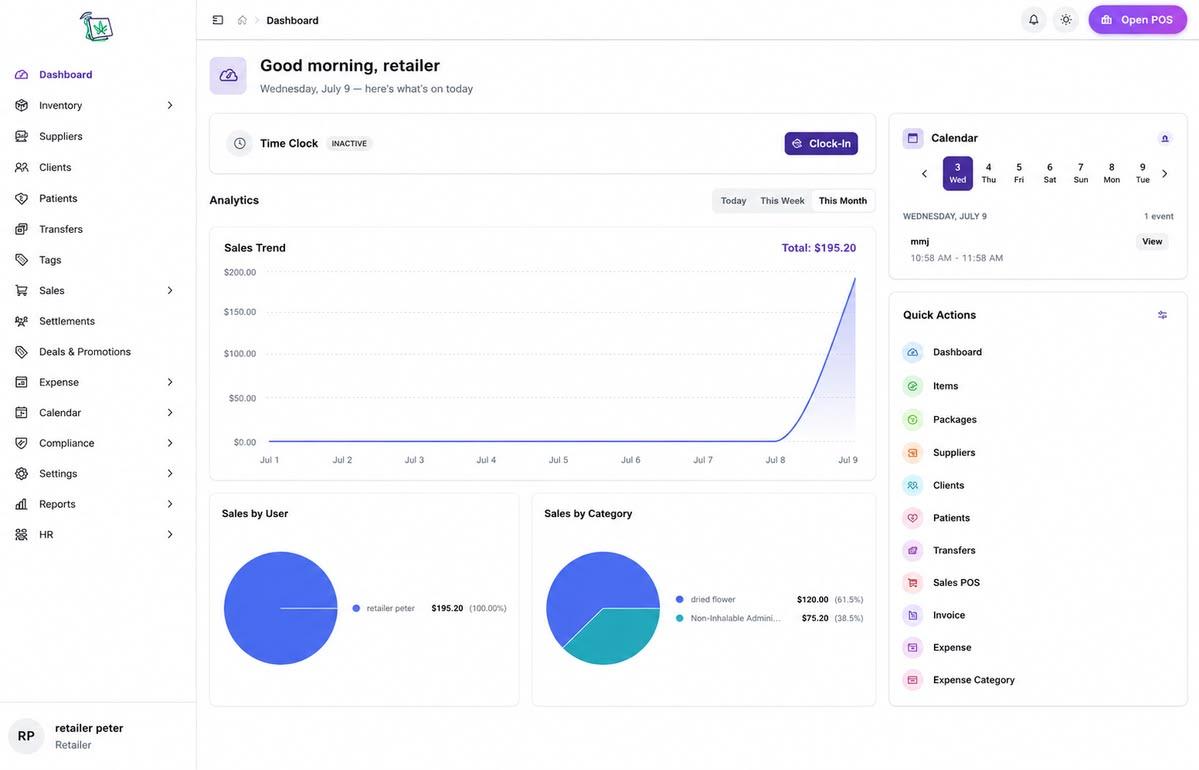
Point of SaleJuly 21, 2026
Cannabis POS System for Retail Dispensaries
A cannabis POS system for retail dispensaries must handle OMMA compliance, package inventory, and fast checkout in one workflow — not as bolt-on modules.
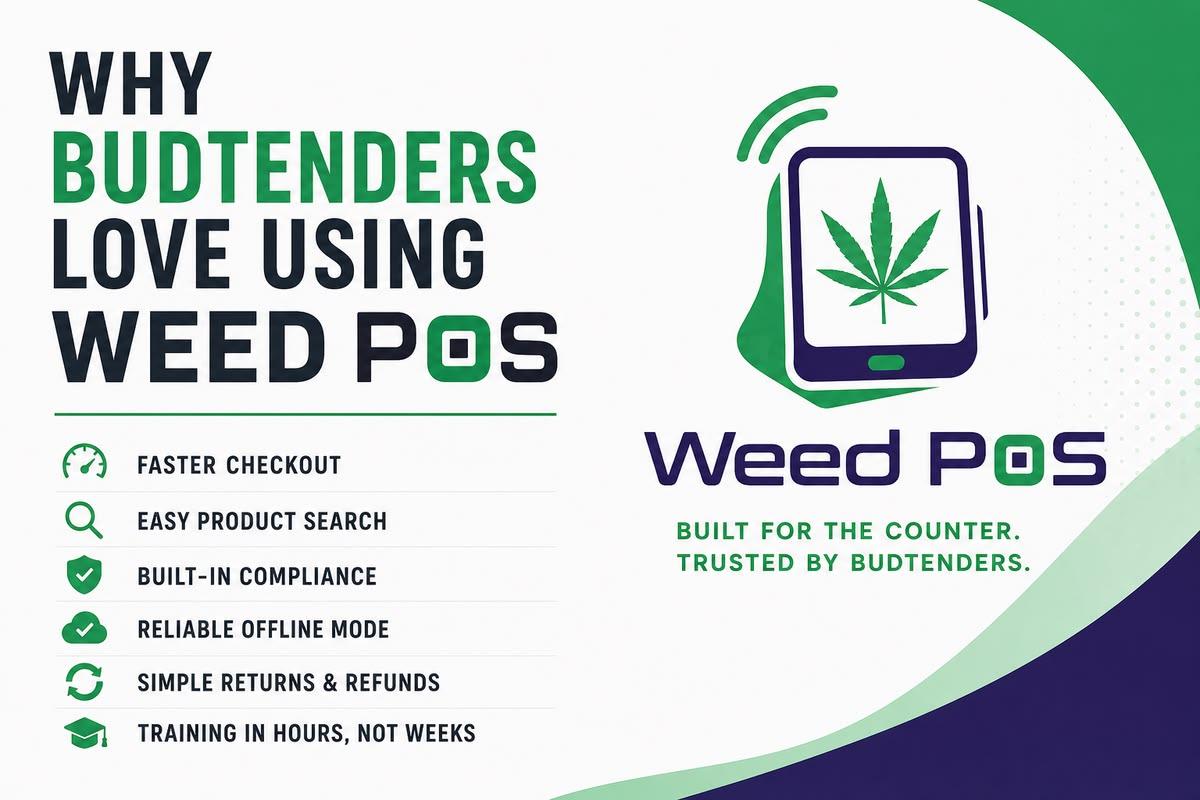
Point of SaleJuly 8, 2026
Why Budtenders Love Using Weed POS
Budtenders need a cannabis POS that keeps checkout fast, compliance automatic, and product search simple — here is why Oklahoma teams prefer Weed POS on busy shifts.
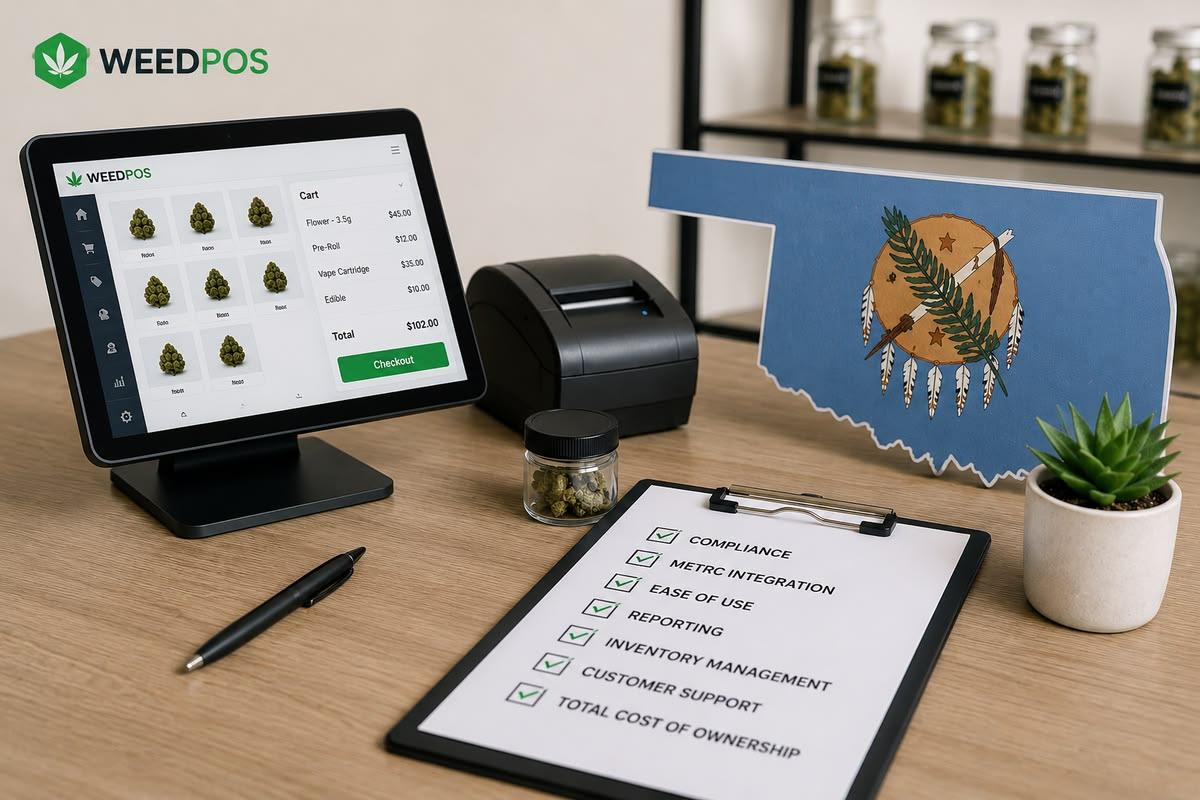
Point of SaleJune 19, 2026
How to Choose a Dispensary POS System in Oklahoma
Step-by-step criteria for selecting the right dispensary POS in Oklahoma, balancing compliance, cost, and operations.