Why Oklahoma Dispensaries Choose Weed POS for METRC Compliance
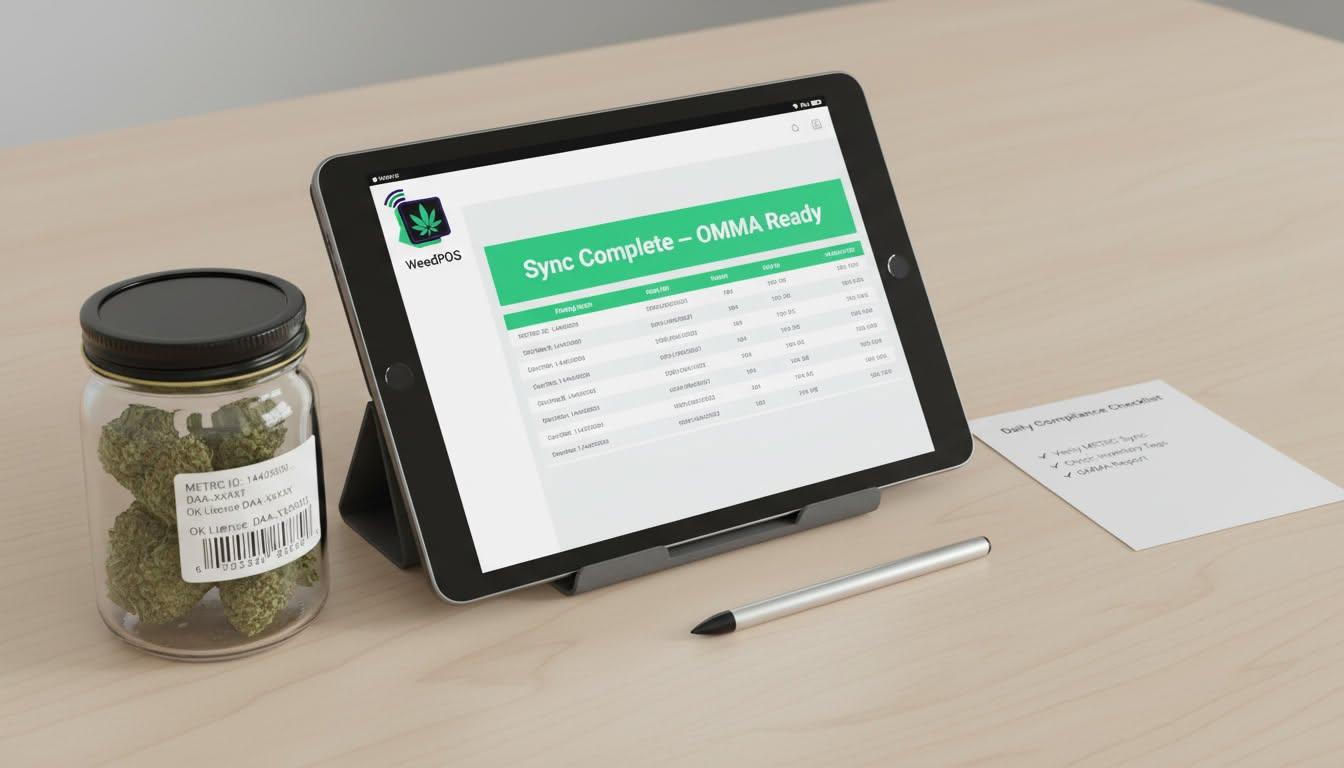
A lot of Oklahoma dispensary operators share the same story: the front counter feels fast, but the back office is cluttered with spreadsheets and state reconciliation. The register does its job. The METRC work does not. That was the gap Weed POS was designed to close.
This post explains why Oklahoma operators choose Weed POS for OMMA-ready METRC workflows. It is not just because the product has a compliance page or a checkbox for "METRC." It is because the system was built for state reporting from the beginning, and because that focus turns the compliance workflow into an operational advantage instead of a weekly tax.
Why full METRC compliance is the core feature, not a nice-to-have
METRC is not optional. Oklahoma's OMMA program expects every tagged package, every sale, every transfer, and every adjustment to be documented accurately. The state is not looking for clever pricing or loyalty bells. It is looking for a clean, continuous audit trail.
That makes compliance the baseline for choosing a cannabis POS in Oklahoma. No product can win the market if it treats METRC as an afterthought. The dispensary that does not need to fight state reporting every weekend is the one that gets whispered about in owner groups and recommended by operators who have already been burned by manual processes.
Weed POS won because it does more than record sales. It connects the register to the state automatically, tracks inventory at the package level, builds transfer manifests with driver and vehicle details, attaches lab certificates correctly, and keeps all of it in a single workflow that staff can trust.
The operational difference: real-time state sync at checkout
The biggest shift is simple: on a generic POS, reporting is separate. You make a sale, and later, usually at the end of the day or week, you have to make that sale count with METRC too.
On Weed POS, that split disappears. Every sale is recorded with OMMA the moment it rings up. Every patient sale, return, and refund is reported in the same workflow the cashier already uses. That means there is no upload step to remember, no replay of the day's activity into a second system, and no separate reconciliation that can be postponed until it becomes a crisis.
That is the kind of workflow that wins the market. Dispensaries do not want a faster manual process. They want the manual process gone.
Package-level inventory: the compliance foundation operators rely on
A price book is not the thing that makes a POS great for METRC. Package tracking is.
Every package on the shelf carries a tag. If your system does not track those tags the way the state expects, you will be behind before you even open the register. If it does, the rest of the compliance work follows.
Weed POS tracks packages, handles splits and combines safely, and ensures inventory numbers stay matched to what OMMA sees. That means when the state asks "Where is this tag?" the answer is the same in your system and theirs.
It also means discrepancies are not a spreadsheet project. When a count is off, the POS raises a precise alert and lets authorized staff correct it with a documented reason. That is the kind of product behavior that builds trust with store managers and helps the system spread by word of mouth.
Transfers, manifests, and inspection readiness
Another place Weed POS has taken market share is in transfer workflows.
Without the right tools, moving product between licenses is a manual pain. You have to assemble driver and vehicle details, pick package tags, and submit the manifest in a separate system. It is exactly the sort of thing that invites mistakes on a busy day.
Weed POS makes it part of the workflow. Manifests are built in a few clicks, with driver, vehicle, and package data pulled from directories you maintain in the system. Multi-stop routes are supported, and the manifest is logged as part of your compliance record.
That operational reliability is huge in Oklahoma, where traffic between dispensaries, processors, and transfers is routine. The product that removes that friction is the product that wins the store floor.
Why audit readiness is an operational advantage
Market share is earned not only by helping dispensaries avoid violations, but by helping them run better in everyday life.
A platform that is always audit-ready gives managers confidence. The inspector's request becomes a report export, not a scramble. The owner moves from worrying about whether the records are complete to using the reports to manage cash, labor, and inventory.
Weed POS wins the market because it turns compliance from a risk into a capability. Customers do not just say "It keeps us compliant." They say "It makes the back office finally feel like a system instead of a homework assignment." That is the kind of language that spreads faster than a feature list.
The economy of saving time with built-in METRC
The financial case is also compelling. The hours you spend on manual METRC work are not free. They are labor hours taken from managers, owners, and staff who could be doing higher-value tasks.
When those hours disappear, the ROI is real. For many dispensaries, switching to Weed POS means reclaiming several hours a week in each location. That is time that can be spent on inventory accuracy, customer service, promotional execution, or simply closing the store on time.
That time saving is what makes Weed POS a market favorite. Operators stop measuring the product by the monthly subscription and start measuring it by the hours it returns.
Why Oklahoma operators choose Weed POS for METRC
The winning combination is not just one feature. It is the way the product treats OMMA compliance as the core workflow:
- Real-time OMMA reporting at checkout
- Package tracking that matches state expectations
- Transfer manifests built into the system
- Lab certificate and potency attachments on intake
- Patient-level sales tracking and purchase limits enforced at the register
- Offline-capable syncing that does not lose transactions
- Discrepancy alerts and correction logging for audit-ready records
That is not a checklist for a generic retail platform. That is the checklist operators care about when they are choosing a dispensary system in Oklahoma.
And because Weed POS was designed around that checklist, it has become the product operators recommend.
Why this matters beyond compliance
The interesting part is that this is not just a compliance story. It is a market story.
When a product solves the hardest part of the business, it opens the door for the other features to matter too. Once a dispensary stops fighting weekly METRC reconciliation, it can pay attention to loyalty, inventory visibility, cash management, and reports. That is why Weed POS is winning overall: the compliance foundation makes the rest of the platform easier to adopt.
If you want to see the full product story, our guides on METRC compliance made simple and why Oklahoma dispensaries are switching to modern cannabis POS systems explain both the compliance win and how the broader market shifts around it.
The bottom line
Weed POS is winning the Oklahoma METRC market because it made compliance the thing that works, not the thing you have to manage.
That means operators can stop spending time on uploads, reconciliation, and audit prep, and start spending time on running their business. It means a register that not only checks IDs and rings sales, but also keeps your inventory matched to the state and your transfers documented correctly.
If your store still feels like it is paying a compliance tax in hours, the right place to start is with a system that was built to reverse that tax. Book a demo and see how Weed POS turns your METRC workflow into an advantage instead of a burden.
Frequently asked questions
Why are Oklahoma dispensaries choosing Weed POS for METRC?
Weed POS is built for Oklahoma OMMA compliance with package tracking, transfer manifests, lab result mapping, and real-time state reporting. That means operators spend less time on manual reconciliation and more time running the store.
Can Weed POS really reduce the hours spent on METRC reporting?
Yes. By recording sales and inventory state-side automatically, the system eliminates end-of-day uploads and minimizes the need for spreadsheet reconciliation, so teams reclaim hours every week.
What makes Weed POS better than a generic retail POS for OMMA?
Weed POS is built around Oklahoma-specific workflows: patient ID checks, package tag pools, transfer manifests, lab certificate attachments, and the audit trail OMMA expects. Generic retail systems do not keep those processes native to the register.
How does Weed POS handle internet outages during METRC reporting?
Offline mode keeps sales flowing locally, queues transactions with original timestamps, and syncs them automatically when the connection returns. That avoids lost records and maintains a clean state audit trail.
Book a Weed POS Demo
See how Weed POS handles OMMA compliance, inventory, and checkout for Oklahoma dispensaries, all in one operating system.
Related articles

ComplianceJuly 16, 2026
Why Oklahoma Dispensaries Need a POS Built Specifically for OMMA
Multi-state cannabis POS platforms spread compliance thin. Oklahoma dispensaries need software built for OMMA workflows — METRC, patient limits, and package inventory from day one.

ComplianceJuly 6, 2026
What Is OMMA Compliance and Why Your POS Matters
OMMA compliance is the operating standard for Oklahoma medical dispensaries — and your POS is where package tracking, patient rules, and METRC reporting actually happen.
ComplianceJune 22, 2026
Why Oklahoma Dispensaries Need Automated METRC Reporting
Automated METRC reporting eliminates time taxes and reduces audit risk—here's why Oklahoma stores need it.