METRC Compliance Made Simple: How the Right POS Saves Oklahoma Dispensaries Hours Every Week
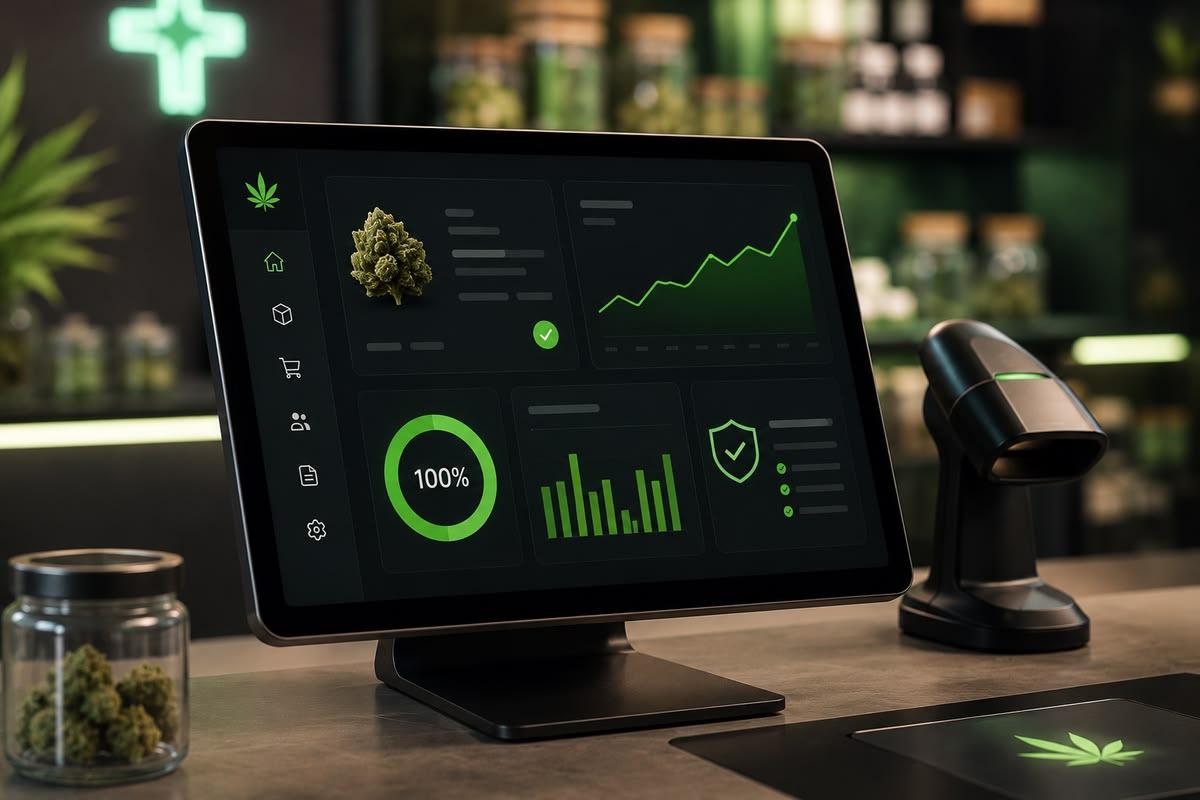
It is Sunday evening, and instead of being done with the week, you are at the back-office computer with two browser tabs and a coffee that went cold an hour ago. One tab is your point of sale. The other is the state's tracking system. Between them is the ritual: pull the week's transactions, line them up against what the state thinks you sold, hunt down the rows that do not match, and key in corrections one at a time before the reporting window closes. It is not hard work. It is just slow, fiddly, unforgiving work that has to be exactly right, and it always seems to land on the evening you wanted back.
That ritual is a time tax, and most Oklahoma operators are paying it without ever putting a number on it. The tax is not the license fee or the subscription. It is the hours — every week, every location — that disappear into manual state reporting, spreadsheet reconciliation, and the low hum of worry that something upstream does not line up. The thesis here is simple and, by now, well proven on real dispensary floors: that tax is optional. With the right point of sale, the reporting happens by itself, the counts stay matched on their own, and the Sunday-evening ritual stops being a thing you do. This is not a story about working harder at compliance. It is a story about not having to — and here is how that shift works, what METRC compliance demands of a dispensary, and where the hours come back.
What METRC compliance requires from an Oklahoma dispensary
METRC is the seed-to-sale tracking system Oklahoma uses under OMMA. The premise is straightforward even if the day-to-day is not: the state wants a continuous, accurate record of every gram of product as it moves through the supply chain, and your dispensary is one link in that chain. If product exists on your shelf, the state expects to know. If it leaves — sold, transferred, adjusted, or destroyed — the state expects to know that too, in the right form and on time.
In practice, that breaks down into a handful of obligations that never stop. First, package tags: every package you receive carries a state tag, and your records have to track that tag from arrival until its contents leave the building. Second, sales reporting: every retail transaction has to be recorded with the state, correct fields populated, so the state's picture of your inventory shrinks in step with your shelf. Third, transfers: when product moves to or from another licensed business, it has to be documented on a manifest naming the driver, the vehicle, and every package on board. Fourth, adjustments: spoilage, breakage, sampling, and recounts all have to be recorded with a reason, because the state notices when a number changes with no explanation attached.
None of those obligations is optional, and none pauses because you had a busy week. This matters in Oklahoma specifically because OMMA inspects, and falling behind on reporting is one of the most common findings inspectors write up. It is rarely a dramatic violation — usually a count that drifted, a manifest that never closed, an adjustment with no reason attached, small gaps that accumulated because the person responsible ran out of hours. The obligation is continuous, so the only sustainable way to meet it is with something that works continuously too.
Where the hours actually go: the manual compliance workflow
To understand the savings, be honest about where the time goes on a generic system, because the cost hides in plain sight: it is not one big task but a dozen small ones, repeated forever.
It starts with end-of-day uploads. On a register that does not speak to the state, somebody has to take the day's sales and report them by hand. Done daily, that is a chore tacked onto every closing shift — pull the transactions, format them, submit them, confirm they landed. Done weekly, because the daily version kept getting skipped on busy nights, it becomes a multi-hour marathon reconstructing a whole week of activity in one sitting. Either way, it is a recurring withdrawal from the same account: your manager's time.
Then comes the spreadsheet layer, where the real hours hide. When the POS does not track inventory the way the state does, operators build a parallel system in a spreadsheet — one view of what is on the shelf, another of what the state believes is there, and a running list of differences nobody has had time to chase down. Every split package, every adjustment, every correction has to be entered twice, and the moment someone forgets one, the numbers start to drift.
The most expensive part is mismatch hunting. When the shelf count and the state count disagree, somebody has to figure out why — scrolling back through transactions, comparing line by line, reconstructing what happened to a package weeks ago from memory and partial notes. A single off-by-one adjustment can cost an afternoon. And the timing is cruel: these mismatches surface right when you can least afford them, when an inspector is at the counter. The manual workflow does not just cost hours; it costs them at the worst possible moment.
How a compliance-first POS changes the workflow
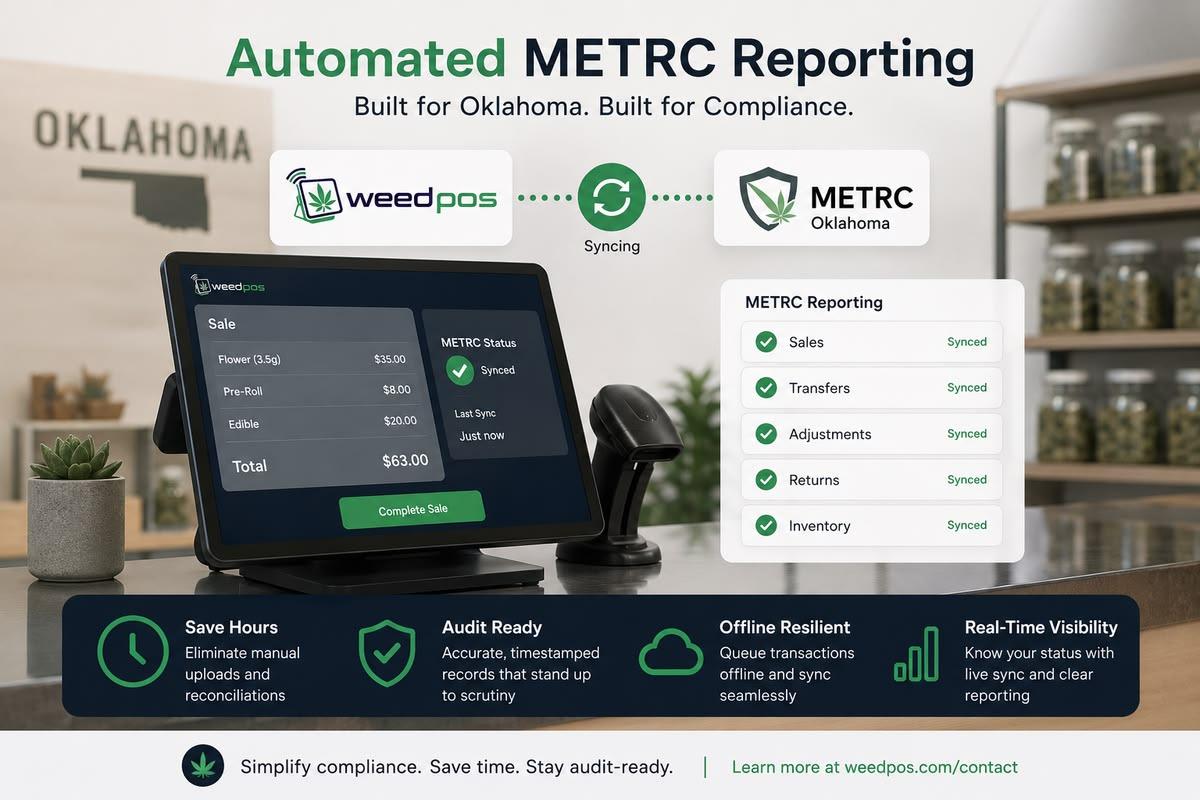
A compliance-first point of sale collapses two steps into one. On a generic register, you record a sale and then, separately, report it to the state. Built-in METRC compliance erases the gap: the recording is the reporting. Every sale is logged with OMMA the moment it rings up — patient sales, returns, and refunds included. There is no end-of-day upload to remember, because there is nothing left to upload. The transaction reported itself the instant it happened.
That single change cascades downstream. Because each sale is recorded with the state at the point of sale, your inventory count and the state's move together in real time instead of drifting apart between reconciliations. The system does the package-level math automatically, so the question that used to define your evenings — does my shelf match what OMMA sees? — stops being one you have to answer, because the answer is built to stay yes. There is no window in which the register and the state silently disagree, and no reconciliation marathon at the end of the week.
The detail operators underrate is that none of this changes the budtender's job. The cashier flow looks exactly the same — pick the patient, scan the product, take payment, hand over the receipt — while the compliance machinery runs underneath, invisible to the person at the counter. Patient ID format checks happen at the register before a sale rings up, catching expired and malformed IDs at the counter instead of during an audit, and purchase limits are enforced automatically. And when the internet drops — a regular event in plenty of Oklahoma locations — offline mode keeps the POS running locally and queues each transaction with its original timestamp, syncing to the state automatically and in order once the connection returns. The work the manual workflow demanded did not get faster. It stopped existing.
Package-level inventory: the foundation of clean reporting
Clean state reporting rests on one thing above all: accurate, package-level inventory. If your packages are tracked correctly, the reporting downstream almost takes care of itself; if they are not, no amount of careful end-of-day work saves you, because you are reporting on a foundation that has already cracked. This is why solid inventory management is the quiet center of compliance, not a side feature.
A real dispensary floor does messy things to packages, and the state expects every one documented. You break a bulk unit down for the shelf — a split. You consolidate the last of two packages — a combine. You discover spoilage, pull a sample, or recount and find the number was off — adjustments. On a generic system, each of those is a manual edit in two places, and every manual edit is a chance for the two to diverge. On a package-aware platform, a split or combine is a tracked operation that keeps your count and the state's correct at the same moment, with no second entry to forget.
Adjustments are where the audit trail proves its worth. When a package is adjusted, the system captures the operator's name, the reason code, the timestamp, and the prior value — automatically, every time. That is not paperwork you maintain; it is a record built as a byproduct of normal work, and a year of that history sits on a single screen. When something does drift — a count that does not line up, a manifest still in transit — the platform raises a discrepancy alert that names exactly what changed, when, and which field. Corrections are made from one screen and logged the same way: operator, timestamp, reason, prior value. Most discrepancies are small and boring, and caught early they are a two-minute fix instead of an afternoon of scrolling. That is the whole point of package-level tracking: you resolve the small things while they are still small.
Manual vs automated METRC workflow
The contrast is clearest side by side. Each row is a task you either do by hand or stop doing entirely.
| Task | Manual workflow | Automated with a compliance-first POS |
|---|---|---|
| Sales reporting | End-of-day or end-of-week uploads, keyed in by hand | Recorded with OMMA automatically the moment each sale rings up |
| Count reconciliation | Shadow spreadsheet, reconciled against the state by hand | Package-level counts stay matched to state records by design |
| Transfer manifests | Assembled manually, driver and packages entered each time | Built in three clicks from a driver and vehicle directory, multi-stop supported |
| Audit prep | Days of pulling and matching records | A report export — the audit trail is already built |
| Error correction | Hunt the mismatch, reconstruct from memory, fix twice | Alert names what changed, when, and which field; correction logged once |
Read the right-hand column as evenings you get back. That is the product.
Audit day: what "always ready" looks like
The truest test of a compliance system is the day an inspector walks in unannounced. On a generic setup, that visit triggers a scramble: someone pulls records, someone else opens the spreadsheet, and the next hour goes to matching your numbers against the state's and rehearsing explanations for the gaps. The stress is not about whether you did anything wrong. It is about whether you can prove you did not — quickly, under pressure, from records that were never built to be handed over.
Now picture the same visit on a platform built for OMMA. The inspector asks about a package adjusted three weeks ago. You do not have to remember — the system does, and the adjustment is on screen with operator, reason code, timestamp, and prior value attached. They ask whether your sales are current with the state; they already are, because every transaction reported itself at the register. They ask about a transfer; the manifest is there. The walkthrough that used to be a performance becomes a series of clicks, because the compliance workspace keeps license paperwork, lab certificates, and inspection records in one inspector-ready place, and the audit trail underneath was assembled transaction by transaction all year.
That is the difference between being audit-ready on audit day and being audit-ready every day: the first is a scramble you hope to pull off, the second is simply the state the system is in. The hours you would have spent preparing were never spent, because there was nothing to prepare.
Choosing a METRC-ready POS
If you are evaluating systems with the time tax in mind, the question is not which one has the longest feature list — it is which actually moves the compliance work off your people. A short, practical checklist:
- Sales report to the state automatically at the point of sale — not as a separate upload step you have to remember.
- Inventory is tracked at the package level and stays matched to state records by design — splits, combines, and adjustments keep both counts correct without a shadow spreadsheet.
- Adjustments capture operator, reason code, timestamp, and prior value automatically — so the audit trail builds itself.
- Transfer manifests are fast to build — a driver and vehicle directory, multi-stop routes, and a manifest in a few clicks rather than manual reentry.
- Lab certificates attach on intake and potency shows at the register — the right numbers on the right product without copy-pasting.
- Patient ID format checks and purchase-limit enforcement live at the counter — catching bad IDs before a sale rings up, not during an audit.
- Offline mode queues sales with original timestamps and syncs on reconnect — so a dropped connection never costs you a sale or a record.
- Discrepancy alerts name what changed, when, and which field — and log every correction, so small gaps get caught while still small.
- It is built for Oklahoma OMMA specifically — a system shaped around one state's rules fits them better than a national tool covering fifty.
If you are weighing this against the broader case for replacing legacy tooling, our companion piece on why Oklahoma dispensaries are switching to modern cannabis POS walks through the full picture — checkout speed, inventory accuracy, and migration — alongside the compliance argument. Weed POS was built against exactly this checklist, because it was written for Oklahoma OMMA from day one rather than retrofitted from a generic retail product.
Conclusion: get the hours back
The case comes down to a single trade. On manual tooling, METRC compliance is a recurring tax your team pays in hours — uploading, reconciling, hunting mismatches, bracing for audits. On a compliance-first point of sale, that tax mostly disappears, because the reporting happens at the register, the counts stay matched on their own, and the audit trail builds itself. Operators making this switch typically reclaim several hours a week per location, and audit prep drops from days to a report export.
Weed POS exists for exactly that outcome, for exactly this market: Oklahoma OMMA-licensed dispensaries done spending Sunday evenings reconciling spreadsheets a system should have kept matched all along. Automatic state reporting, package-level inventory, and an operator-stamped audit trail are not premium extras — they are the baseline a METRC-ready POS should clear.
The hours you get back are the whole return, and the easiest way to see them is to watch it run on your own numbers. Schedule a demo and we will walk your team through a real sale syncing to the state, a package adjustment landing in the audit trail, and a discrepancy alert — so you decide with your own eyes, not a feature sheet.
Frequently asked questions
What is METRC and why does my Oklahoma dispensary need to use it?
METRC is the seed-to-sale tracking system Oklahoma uses under OMMA. Every package on your shelf, every sale, and every transfer must be recorded with the state. Falling behind on reporting is one of the most common findings in OMMA inspections.
Can a POS really automate METRC reporting?
Yes. A cannabis-specific POS records each sale with the state the moment it rings up, keeps package counts in sync automatically, and builds transfer manifests from the same data. The budtender workflow does not change — the reporting happens in the background.
What happens to METRC reporting if my internet goes down?
With an offline-capable POS, sales continue locally and queue with their original timestamps. When the connection returns, queued transactions sync to the state automatically and in order, so your records stay complete.
How much time does automated METRC compliance actually save?
Operators switching from manual end-of-day uploads typically reclaim several hours per week per location — the time previously spent reconciling spreadsheets, fixing mismatched counts, and preparing for audits. Audit prep itself drops from days to a report export.
Book a Weed POS Demo
See how Weed POS handles OMMA compliance, inventory, and checkout for Oklahoma dispensaries, all in one operating system.
Related articles

ComplianceJuly 16, 2026
Why Oklahoma Dispensaries Need a POS Built Specifically for OMMA
Multi-state cannabis POS platforms spread compliance thin. Oklahoma dispensaries need software built for OMMA workflows — METRC, patient limits, and package inventory from day one.

ComplianceJuly 6, 2026
What Is OMMA Compliance and Why Your POS Matters
OMMA compliance is the operating standard for Oklahoma medical dispensaries — and your POS is where package tracking, patient rules, and METRC reporting actually happen.
ComplianceJune 22, 2026
Why Oklahoma Dispensaries Need Automated METRC Reporting
Automated METRC reporting eliminates time taxes and reduces audit risk—here's why Oklahoma stores need it.