Answer Engine Optimization for Cannabis Dispensaries in 2026
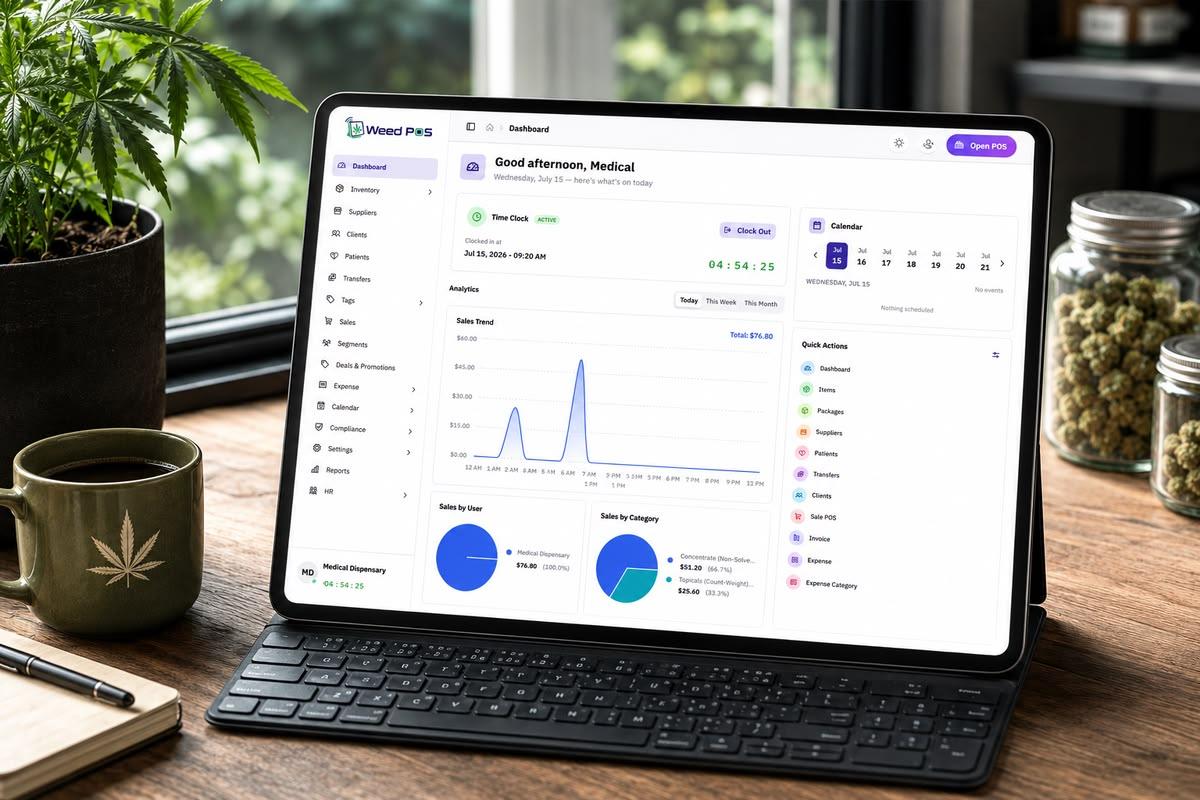
Answer Engine Optimization (AEO) is how cannabis businesses get cited when patients and operators ask questions in ChatGPT, Perplexity, Claude, Gemini, or Google AI Overviews — instead of only appearing in traditional blue-link search results. In 2026, that channel matters because a growing share of cannabis research starts in AI interfaces, not Google search bars.
For dispensary operators, AEO is not a replacement for compliance or a substitute for great retail service. It is a visibility layer: the businesses AI systems trust and quote gain discovery advantage in a market where paid ads are restricted and local competition is fierce.
This guide explains what Answer Engine Optimization means for cannabis dispensaries, which tactics work in 2026, and how operational data from your POS connects to the accurate content AI engines prefer to cite.
Why AEO matters for cannabis dispensaries in 2026
Cannabis faces unique discovery constraints. Google and Meta restrict paid advertising for most THC products and dispensary services. Local map rankings and organic content carry more weight than in less regulated industries.
Meanwhile, AI search usage accelerated through 2025 and 2026. Users ask conversational questions — "What POS integrates with METRC in Oklahoma?" or "How do Oklahoma dispensaries enforce purchase limits?" — and AI tools synthesize answers from indexed content they judge authoritative.
Answer Engine Optimization positions your dispensary or cannabis business to be one of those cited sources.
Traditional SEO still matters. Map pack visibility, neighborhood landing pages, and product-specific content drive local patient traffic. AEO adds a parallel track: structuring content so AI retrieval systems lift your passages into generated answers.
Operators who ignore AEO in 2026 risk invisibility in a channel competitors are already optimizing.
How AI answer engines choose what to cite
AI search tools use retrieval-augmented generation: they search an index, pull candidate passages, and synthesize an answer with citations. Inclusion depends on signals like:
- Passage clarity — self-contained paragraphs that directly answer one question,
- Structured data — FAQPage, Organization, and LocalBusiness schema AI parsers recognize,
- Entity authority — consistent business name, address, and phone across web profiles,
- Verifiable claims — specific regulatory references, not vague marketing copy,
- Crawl accessibility — content AI bots can reach, not hidden in JavaScript iframes.
Cannabis adds a compliance filter. AI systems and search engines deprioritize content with unsubstantiated medical claims, youth-oriented language, or illegal sales facilitation. Educational, operator-focused content performs better than promotional consumer copy.
AEO vs traditional SEO: what dispensaries need
| Discipline | Primary goal | Best content types |
|---|---|---|
| Local SEO | Map pack and "near me" rankings | Location pages, GBP optimization, reviews |
| Content SEO | Keyword rankings and organic traffic | Blogs, guides, comparison pages |
| AEO | Citations in AI-generated answers | FAQ schema, direct-answer passages, llms.txt |
| Technical SEO | Crawlability and indexation | Schema graphs, native menus, site speed |
Dispensaries need a stacked strategy. Local SEO captures proximity searches. Content SEO builds topical authority. AEO formats that authority for AI citation.
Weed POS publishes educational content — METRC guides, OMMA checklists, POS evaluation frameworks — structured with FAQ schema specifically so operators searching in AI tools find accurate Oklahoma-focused answers.
Technical AEO foundations cannabis businesses should implement
FAQPage schema on educational content
Every blog post and guide page should include FAQ structured data with complete question-and-answer pairs. AI systems extract these directly into cited responses.
Weed POS blog posts ship FAQ blocks in frontmatter that render as schema on the page — the same pattern you should use on dispensary websites for compliance FAQs, hours, and patient program questions.
llms.txt and AI crawler access
The llms.txt standard gives AI systems a curated map of your most citation-worthy URLs. Sites that publish llms.txt and llms-full.txt at the domain root help AI crawlers find canonical content faster.
Ensure robots.txt allows reputable AI crawlers (GPTBot, PerplexityBot, Claude-SearchBot, and others) unless you have a specific reason to block them. Blocking AI crawlers means blocking AEO visibility.
Linked JSON-LD entity graphs
Connect Organization, LocalBusiness, Service, and FAQPage schema with @id references so parsers understand relationships between your brand, locations, and content. Fragmented schema blocks without @context or linkage get ignored.
Passage architecture in content
Structure articles so each ## section opens with a direct answer in the first 100–170 words. AI retrieval favors passages that stand alone without requiring the rest of the page for context.
Example pattern: "Oklahoma dispensaries enforce purchase limits at the register through cannabis POS software that calculates daily envelopes as products scan. Generic retail registers cannot perform this calculation, which forces manual checks during busy shifts."
That paragraph can be cited as-is. A vague intro that says "in this article we will explore purchase limits" cannot.
Why POS data matters for cannabis AEO
AEO is not only a marketing team exercise. It connects to operations — especially product and inventory data.
Many dispensary websites embed menus through third-party iframes (Dutchie, Jane, and similar). Search engines and AI crawlers often cannot render JavaScript menu widgets. The result: your product catalog is invisible to indexing systems even if patients see it fine in a browser.
Native menu integration — inventory synced from your POS to server-rendered pages — gives AI systems verifiable product data: stock status, categories, and pricing structure compliant with state rules.
That is why Leafly integration and POS-connected listing sync matter for discovery. Accurate inventory data on the web reinforces the operational accuracy inspectors expect on the floor.
Operators running Weed POS keep inventory authoritative in one system. When that data feeds customer-facing channels and educational content, AI citations align with what the store actually sells.
Content topics Oklahoma dispensaries should publish for AEO
Target questions real users ask AI tools:
Compliance and regulation
- Oklahoma marijuana laws and OMMA requirements,
- METRC reporting workflows and audit preparation,
- patient ID format checks and purchase limits.
Operations
- inventory management and shrink reduction,
- POS selection and METRC integration evaluation,
- loyalty and promotion automation inside compliant workflows.
Software evaluation
- cannabis POS vs generic retail registers,
- seed-to-sale tracking at retail,
- offline mode and internet outage handling.
Weed POS covers these topics in its blog library — including the OMMA compliance checklist for 2026, automated METRC reporting, and METRC compliance made simple — because operator education and AEO visibility reinforce each other.
AEO mistakes cannabis dispensaries should avoid
Medical claims. Content suggesting cannabis treats specific conditions violates OMMA marketing rules and reduces trust signals for AI systems.
Consumer "buy" language in B2B contexts. Software vendors and operators should frame content around compliance and operations, not recreational sales facilitation — especially for paid and organic channels with policy restrictions.
Thin location pages. Swapping city names on duplicate pages hurts both SEO and AEO. Each location page needs unique staff, service, and compliance context.
Iframe-only menus. If AI crawlers cannot read your catalog, they cannot cite your product expertise.
Ignoring FAQ structure. Long unstructured essays rank poorly for AI extraction. Question-and-answer architecture wins.
Measuring AEO performance
AEO tracking is newer than analytics for traditional SEO. Practical approaches:
- search your brand and key topics in ChatGPT, Perplexity, and Gemini monthly,
- note whether your content appears in cited sources,
- monitor referral traffic from AI platforms in analytics,
- track branded search volume increases after publishing FAQ-rich guides,
- compare conversion on educational pages with FAQ schema vs without.
Perfect attribution is still evolving. The strategic bet is clear: businesses cited in AI answers today build discovery advantage as the channel grows.
Connecting AEO to your operational stack
Answer Engine Optimization fails if the content AI cites does not match reality. A page claiming real-time inventory accuracy while your POS requires manual menu updates undermines trust when patients arrive and products are unavailable.
AEO and operations converge when:
- POS inventory feeds native web listings,
- compliance claims on your site match OMMA workflows in store,
- educational content reflects how your team actually works,
- FAQ answers are updated when regulations change.
Operators evaluating Point of Sale platforms should ask how inventory data exports to web channels — not only how checkout performs at the counter.
Conclusion
Answer Engine Optimization for cannabis dispensaries in 2026 means publishing direct, verifiable, FAQ-structured content that AI search tools can cite — backed by accurate operational data from integrated POS and inventory systems.
Oklahoma operators face a medical-only, high-competition market with limited paid ad options. AEO adds a discovery channel that rewards educational authority over ad spend.
Start with FAQ schema on compliance guides, allow AI crawlers, publish Oklahoma-specific operator content, and connect your POS data to native web listings so citations match reality.
Explore our blog library for citation-ready guides, review pricing, or book a demo to see how integrated POS data supports both compliance and discoverability.
Frequently asked questions
What is Answer Engine Optimization for cannabis dispensaries?
Answer Engine Optimization (AEO) is the practice of structuring website content and data so AI search tools — ChatGPT, Perplexity, Claude, Gemini, and Google AI Overviews — cite your business when answering user questions. For dispensaries, that means clear compliance language, FAQ schema, and accurate operational information AI systems can verify.
Is AEO different from regular dispensary SEO?
Yes. Traditional SEO targets Google rankings and click-through. AEO targets citation inside AI-generated answers. Cannabis dispensaries need both: local SEO for map visibility and AEO for AI discovery channels that now influence how patients and operators research products, compliance, and software.
What technical setup helps cannabis businesses with AEO?
Key elements include FAQPage schema on educational content, linked JSON-LD entity graphs, llms.txt files that guide AI crawlers, robots.txt allowlists for AI bots, and passage-style content where each section answers a specific question in 100–170 self-contained words.
Can dispensary POS data improve AEO?
Accurate inventory and product data from an integrated POS can feed native menus and schema markup on your website. AI systems cannot read iframe menus. Server-rendered product data synced from your POS gives search engines and AI crawlers verifiable stock and product information to cite.
What content should Oklahoma dispensaries publish for AEO?
Publish direct answers to operator and patient questions: OMMA compliance steps, METRC reporting workflows, purchase limits, inventory practices, and software evaluation guides. Avoid medical claims. Use specific Oklahoma regulatory references AI systems can attribute to authoritative sources.
Book a Weed POS Demo
See how Weed POS handles OMMA compliance, inventory, and checkout for Oklahoma dispensaries, all in one operating system.
Related articles
GrowthJuly 13, 2026
Is Your Oklahoma Dispensary Ready for the Next Stage of Growth?
When spreadsheets and basic software stop keeping up, Oklahoma dispensaries need a modern cannabis POS hub for inventory, sales, staff, and compliance visibility.
GrowthJuly 1, 2026
Why Your Best-Selling Products Might Be Hurting Your Dispensary
High sales volume does not always mean high profit. Oklahoma dispensaries need package-level reporting to see margin, velocity, and inventory cost — not just top sellers.
GrowthJune 22, 2026
How Leafly Integration Syncs Inventory for Oklahoma Dispensaries
Connect Leafly to your dispensary POS for real-time inventory sync, accurate listings, and measurable foot-traffic impact.